 Kaomoji Club
How to read Japanese emoticons
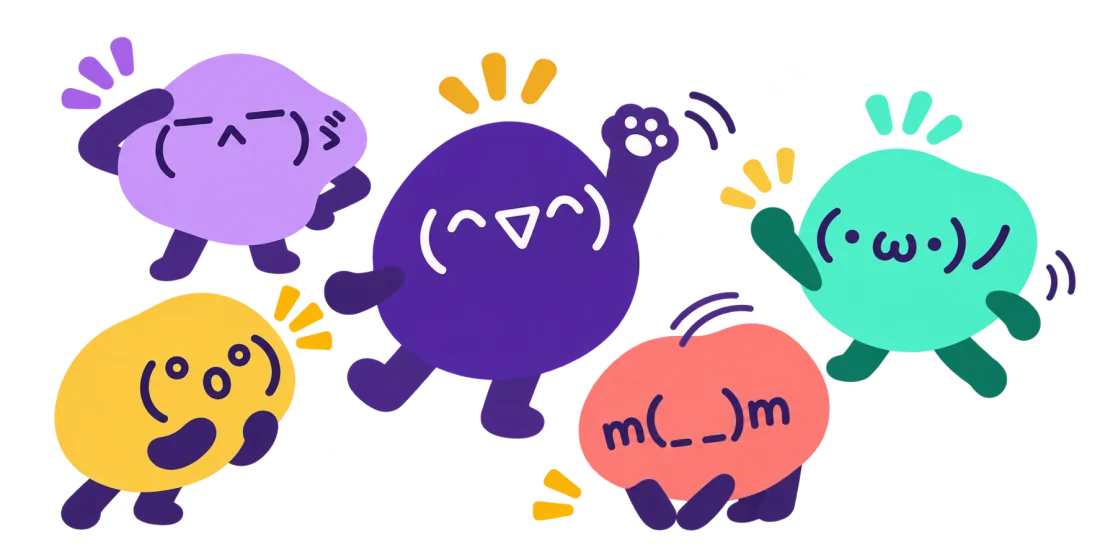
Read the face upright. Brackets often outline the face, marks on either side suggest eyes, and the middle mark is usually the mouth. A stroke after the brackets can act as a hand. For example, (・ω・)ノ looks like a face with a raised arm. In m(_ _)m, the lowered middle and two outer letters suggest a bowed head and hands.
Which face fits a greeting or apology?
A wave after “Hi” makes an easy opener in a casual group. For a small mistake, write a plain apology and add a bow if that tone fits the conversation. When the mistake matters, leaving the face out can keep the apology clear. A bow can also accompany thanks, so read the sentence around it to tell the difference.
What’s the difference between surprise and confusion?
Open eyes and a round mouth, as in (°o°), suggest a sudden reaction. A question mark in (・・?) points toward uncertainty. Use the surprised face after a revelation and the puzzled one while asking someone to explain. The message above gives the same set of marks its context.
Choose a short or expressive face
A simple smile such as (^_^) is easy to type and leaves room for your words. An arm, a bow, or a wide pair of eyes adds more detail where your message can support it. If you need an unmistakably cheerful face, try the happy collection. For a softer greeting with flowers or little paws, explore cute kaomoji.
Do I need a Japanese keyboard?
You can copy any example here with the copy button. Use a regular text field to paste it. A face with unusual characters may take more space than it appears to take on this page.