No matching faces. Try a shorter search or another collection.
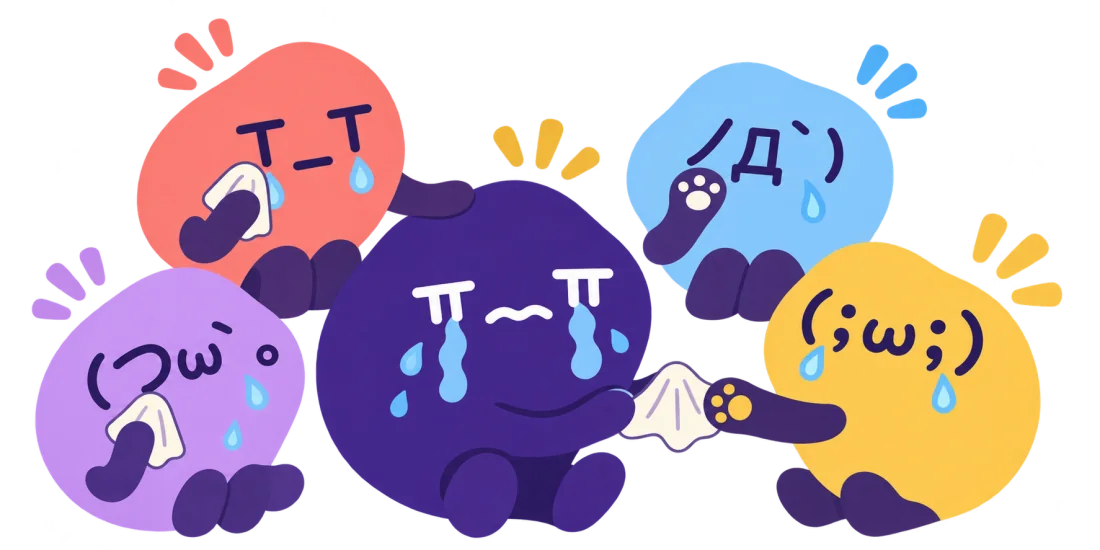
Crying kaomoji for quiet tears and big reactions
Face
When to use it
Example message
(T_T)
A compact face with tears on both sides.
I missed the finale. (T_T)
(╥﹏╥)
Two streams of tears and a trembling mouth.
I dropped my last cookie. (╥﹏╥)
(つω`。)
A hand near the eye for wiping a quiet tear.
I’ll miss you. (つω`。)
(;▽;)
Tears with a smile for joy or laughter.
I’m so happy you’re here. (;▽;)
How do crying kaomoji show tears?
Two tall marks, such as the Ts in (T_T) or the ╥ shapes in (╥﹏╥), look like tears running down the face. Marks around the outside can suggest flying tears, and a stroke over one eye can look like a hand wiping it. The mouth helps tell you whether the tears are sad, delighted, or part of a joke.
Choose a crying face that matches the message
Quiet tears
Pick a face with one small tear or one hand near the eye when you’re writing a gentle “I’ll miss you.” The face should sit naturally after the sentence. A face with scattered tears may sound more dramatic than you intend.
A big, playful sob
A larger face works well for an exaggerated complaint among friends. In a short or ambiguous message, explain what happened so the recipient knows whether it’s serious. For a real loss or difficult news, words of support are the most important part of a reply.
Tears of joy or laughter
Look for a smiling mouth, as in (;▽;). A happy sentence before it makes the meaning clear, whether you’re laughing at a story or reacting to good news. Browse happy kaomoji if the smile is the part you want to emphasize.
What’s the easiest crying kaomoji to type?
(T_T) uses two capital Ts, an underscore, and parentheses. It’s a compact choice for a short reply. See sad kaomoji for a quiet letdown or an expression without visible tears.
 Kaomoji Club